From a disease no one can ignore to a molecule designed by a new kind of engine
The story of rentosertib begins before it had a name, before it had a chemical structure, and before TNIK was visible to most people watching idiopathic pulmonary fibrosis. It begins with a hard disease and an uncomfortable question for the pharmaceutical industry: if aging biology is deeply entangled with chronic disease, can artificial intelligence help find therapeutic targets that human intuition has not prioritized enough?
Idiopathic pulmonary fibrosis, or IPF, gives drug developers almost no room for easy optimism. The lung tissue that should remain elastic and capable of oxygen exchange becomes stiff, scarred and progressively compromised. Patients often experience worsening breathlessness, cough, declining exercise capacity and, over time, irreversible loss of lung function. Existing antifibrotic medicines can slow decline for some patients, but they do not reverse the disease. The need for new mechanisms remains urgent.
For Insilico Medicine, IPF became more than an indication. It became a test of a thesis the company had been building since its earliest years: that deep learning, generative chemistry, multi-omics biology, natural-language processing and translational prediction could be connected into one drug-discovery engine. The ambition was not merely to make the old process faster. The harder ambition was to originate a therapeutic hypothesis, identify a novel target, design a novel molecule against it, validate that molecule experimentally and then test it in humans.
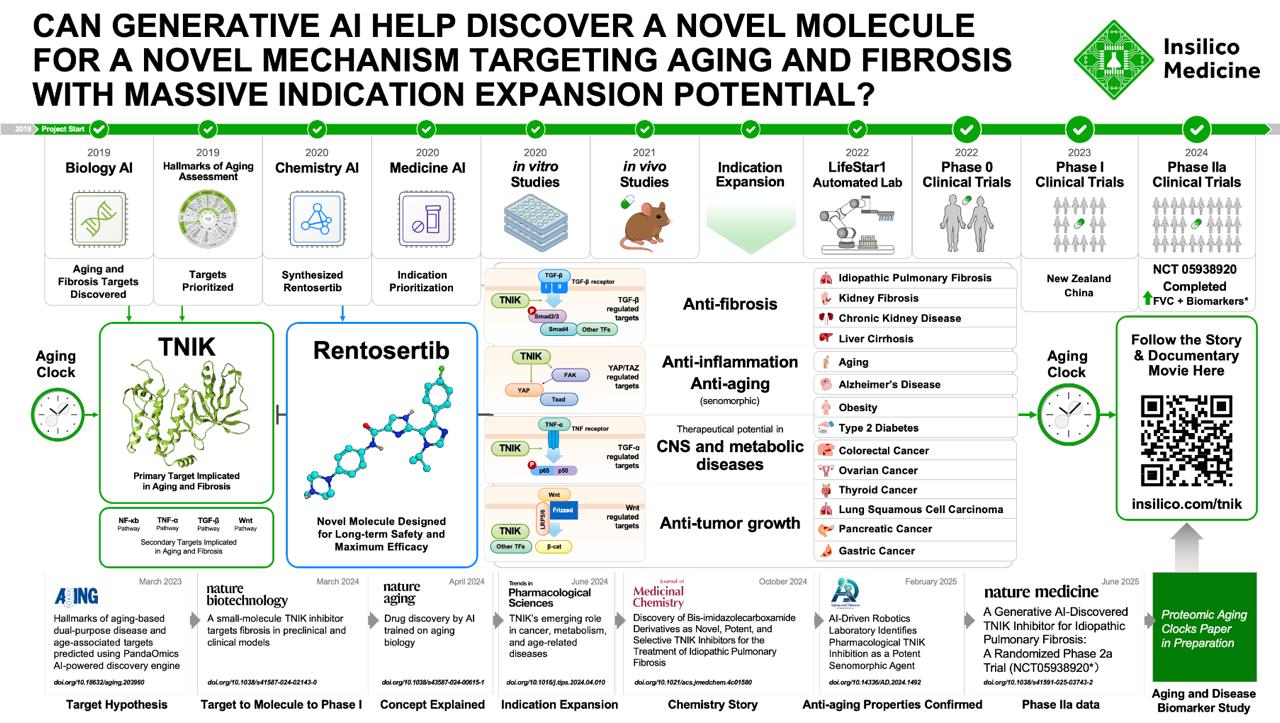
Rentosertib is the result of that wager. Formerly known as ISM001-055 and INS018_055, it is an investigational oral small-molecule inhibitor of TNIK, TRAF2- and NCK-interacting kinase, being developed for IPF. Its importance comes from the chain of custody: an AI-prioritized target, a generative-AI-designed molecule, preclinical fibrosis biology, Phase 0 and Phase I human safety and pharmacokinetic work, randomized Phase IIa patient data, peer-reviewed publications in Nature Biotechnology, Nature Medicine and the Journal of Medicinal Chemistry, and finally a Phase III trial designed to test whether early signals can translate into durable clinical benefit.
This is not a story of approval. Rentosertib remains investigational. It is not a proven cure for IPF, and it is not a proven anti-aging therapy. But it is already one of the most complete public narratives of an AI-originated therapeutic program moving from first concept to late-stage clinical development. That is why the journey matters.
Insilico Medicine was founded in 2014, as deep learning was moving from academic excitement into industrial transformation. The company’s early identity sat at the intersection of aging research and AI: use data-rich biological systems, omics profiles, literature, patents, grants, clinical-trial records and modern machine learning to understand disease mechanisms and discover interventions.
Over time, that ambition became Pharma.AI, an end-to-end platform designed to connect biology, chemistry and medicine. PandaOmics supported target discovery and disease modeling. Chemistry42 supported generative small-molecule design and optimization. Medicine42 and inClinico supported translational and clinical-development reasoning. The strategic difference was the attempt to make these pieces work as one conveyor, not as isolated software demonstrations.
The company’s earlier generative chemistry work, including the 2019 GENTRL publication, helped establish that deep generative reinforcement learning could design molecules quickly under multiple constraints. GENTRL was not the rentosertib program itself, but it set the stage for what came next. After a generative-chemistry proof point, the larger question became sharper: could the same AI-first organization find a target, design a molecule and take the program into real clinical development?
The rentosertib path began at the end of 2019, after GENTRL, with an IPF target-discovery campaign. The platform analyzed fibrosis datasets annotated by age and sex, biological networks, literature and other biomedical evidence. It scored genes and pathways, reconstructed disease-relevant networks, assessed novelty and disease association through natural-language processing, and proposed targets for validation. According to Insilico’s public materials, the system revealed 20 targets for validation, and one novel intracellular target became the priority for further analysis.
That target was TNIK. TNIK is a serine/threonine kinase connected to several pathways relevant to fibrosis and inflammation, including Wnt, TGF-β, Hippo/YAP-TAZ, JNK and NF-κB signaling. In the Nature Biotechnology discovery-to-clinic paper, TNIK was reported as the top-ranked candidate in a protein and receptor kinase discovery scenario. This mattered because the existing IPF therapeutic landscape had not been built around TNIK. The target represented a different biological angle from the receptor tyrosine kinase biology addressed by established antifibrotic drugs.
The target also fit Insilico’s aging-biology thesis. IPF is a disease in which aging, chronic inflammation, extracellular matrix remodeling, cellular senescence and tissue fibrosis intersect. Insilico and collaborators had described a hallmarks-of-aging-based strategy for identifying dual-purpose disease and age-associated targets using PandaOmics. Later, a Nature Aging research highlight described the use of AI trained on aging biology to analyze IPF datasets and prioritize targets, with TNIK emerging as a top candidate.
That did not make TNIK magic. It made TNIK testable. The program moved from a computational target hypothesis into the discipline of experiments, where every elegant idea has to survive contact with biology.
Once TNIK was prioritized, the challenge shifted from biology to chemistry. A target hypothesis is not a drug. It has to be translated into a molecule with potency, selectivity, solubility, metabolic stability, safety margins, pharmacokinetics and a path to manufacturing and clinical dosing. Insilico used Chemistry42, its generative chemistry engine, to design and optimize candidate molecules against the target.
Chemistry42 has been described as using hundreds of predictive pre-trained models and multiple generative approaches, including transformer-based methods, GANs, genetic algorithms and reinforcement-learning-style reward systems. The goal was to generate structures that satisfied competing constraints: bind TNIK, remain drug-like, avoid unacceptable liabilities and preserve the properties needed for development.
Public Insilico materials say scientists selected 79 molecules to synthesize, and the 55th molecule showed the promise that eventually drove the program forward. The molecule series demonstrated nanomolar target inhibition, and optimization improved solubility, ADME properties and CYP inhibition profiles while retaining potency. The program’s medicinal chemistry was later disclosed in the Journal of Medicinal Chemistry paper on bis-imidazolecarboxamide derivatives as novel, potent and selective TNIK inhibitors for IPF.
This is one of the reasons rentosertib is more than a slogan about AI. The chemical trail is public. The molecule was not merely described as “AI-designed”; its chemotype, optimization logic and structural support became part of the peer-reviewed record. In a field where many AI-drug-discovery claims remain high-level, that transparency matters.
Then came the unforgiving middle of every drug-discovery story: biology had to answer. Could inhibiting TNIK with the generated compounds change fibrosis-relevant phenotypes? In public materials, the ISM001 series showed activity in preclinical models, including a bleomycin-induced mouse lung fibrosis model, with improvements in fibrosis and lung-function-related measures. The candidate also demonstrated a favorable safety profile in a 14-day repeated mouse dose range-finding study.
The final candidate, ISM001-055, moved into IND-enabling studies. Insilico has described the preclinical-development arc as unusually rapid: candidate nomination in roughly 18 months from project start, compared with much longer traditional discovery timelines. The 2021 first-in-human blog reported a preclinical program budget of around $2.6 million, while emphasizing that the platform linked target discovery and generative chemistry into a more industrialized workflow.
The biological evidence also expanded beyond lung fibrosis. Insilico materials described testing across lung, kidney and skin fibrosis models. The molecule’s mechanism was tied to myofibroblast activation, extracellular matrix remodeling and broader fibrosis pathways. The point was not only that a compound hit TNIK in a biochemical assay. The point was that the program began to show phenotypic evidence consistent with a therapeutic hypothesis.
At this point, the rentosertib story had three legs: an AI-prioritized target, an AI-designed molecule and an experimental fibrosis package. But the history of drug discovery is full of preclinical successes that fail in humans. The next test was whether the molecule could cross into people.
In November 2021, Insilico initiated a first-in-human exploratory microdose trial of ISM001-055 in Australia. The study began characterizing pharmacokinetics and safety in healthy volunteers. For the company, this was not just another early clinical step; it was the first time the AI-discovered target and AI-designed molecule concept crossed into human testing.
The Phase I program then expanded. Public materials describe a New Zealand Phase I study enrolling 78 healthy volunteers across single-ascending-dose and multiple-ascending-dose cohorts. In January 2023, Insilico announced positive topline Phase I results, reporting that the compound was safe and well tolerated in volunteers, with no significant accumulation after seven days and a favorable pharmacokinetic profile. The U.S. FDA granted Orphan Drug Designation for IPF in February 2023.
These steps formed the translational bridge between a computational story and a clinical story. The early human work did not prove efficacy in IPF. It did something more basic but essential: it supported moving the drug into patient testing. Without that step, the AI narrative would have remained trapped in preclinical proof.
By then, the compound had acquired several names — INS018_055, ISM001-055 and eventually rentosertib — but the underlying arc was becoming clearer. The program had moved from target hypothesis into molecule, from molecule into animal models, and from animal models into healthy volunteers. The next test would ask whether the mechanism showed a clinical signal in patients.
In 2023, Insilico began Phase II testing with IPF patients. The Phase IIa GENESIS-IPF study was a multicenter, randomized, double-blind, placebo-controlled trial in China. In the Nature Medicine publication, 71 patients with IPF across 22 sites were randomized to placebo, rentosertib 30 mg once daily, rentosertib 30 mg twice daily, or rentosertib 60 mg once daily for 12 weeks.
The study met its primary safety and tolerability objective. Treatment-emergent adverse event rates were similar across treatment arms. Secondary and exploratory analyses showed a dose-dependent lung-function signal. The 60 mg once-daily arm demonstrated a mean forced vital capacity change of +98.4 mL at 12 weeks, compared with -20.3 mL for placebo in the official Phase III release. Exploratory biomarker analyses supported the proposed anti-fibrotic and anti-inflammatory mechanism, with changes in profibrotic and inflammatory proteins consistent with TNIK pathway modulation.
For patients, a 12-week Phase IIa signal is not a guarantee. For the field, however, it changed the status of the program. Rentosertib was no longer only an AI-originated molecule with early safety evidence. It had randomized patient data, peer-reviewed clinical publication and a rationale for larger, longer testing.
Many AI drug-discovery stories are difficult to evaluate from the outside. A company may announce that a molecule was designed with AI, while the target, chemistry, validation data and clinical results remain partly opaque. Rentosertib is different because the public record spans multiple layers.
The Nature Biotechnology paper documents the discovery-to-clinic arc: target discovery, TNIK prioritization, Chemistry42-driven molecular design, preclinical models and Phase I evidence. The Journal of Medicinal Chemistry paper documents the medicinal chemistry foundation of the TNIK inhibitor series. The Nature Medicine paper documents randomized Phase IIa clinical results. Additional Aging, Nature Aging and Aging and Disease publications connect the program to hallmarks-of-aging target discovery, senomorphic biology and TNIK’s relevance to age-associated disease mechanisms.
There is also a public storytelling layer: Insilico’s prior blogs on preclinical candidate nomination, first-in-human work, Phase I, Phase II, Phase II readout and the official Phase III release. The existing encyclopedia site includes an original visual history slide, a paper stack, a media timeline, the official release, the HBS case link and a documentary/Docuthon pointer. That transparency is one of rentosertib’s strategic meanings. Even if Phase III remains an open clinical question, the program is already a benchmark for how an AI-originated drug-discovery story can be documented.
Aging biology is central to the story, but it needs careful wording. IPF is an age-related disease, and fibrotic remodeling, senescence, chronic inflammation and extracellular matrix changes are all connected to aging processes. Insilico’s early target-discovery thesis explicitly used aging-informed biology to help prioritize targets for disease.
The Aging paper on hallmarks-of-aging-based target discovery provided a conceptual foundation for dual-purpose disease and age-associated targets. The Nature Aging highlight described how PandaOmics was used to connect IPF multi-omics datasets, biological networks and hallmarks-of-aging assessment. The Aging and Disease paper on AI-driven robotics laboratory work reported pharmacological TNIK inhibition as a potent senomorphic strategy in cellular senescence models, with reductions in SASP and extracellular matrix remodeling signals.
These pieces strengthen the scientific rationale for studying TNIK at the intersection of fibrosis, inflammation and senescence. They do not establish rentosertib as an approved anti-aging therapy. They do not convert exploratory biomarkers or aging-clock analyses into registrational endpoints. The safest public frame is that aging biology helped inform the disease and target-discovery logic, and that senomorphic and aging-clock evidence add mechanistic context for future research. Rentosertib may be a major story for AI and aging biology without becoming an overclaimed longevity product. Its primary clinical test is in IPF.
On July 7, 2026, Insilico announced the initiation of the Phase III clinical trial for rentosertib. The Phase III clinical-trial identifiers are CTR20262475 and NCT07687459. The official release describes the trial as a prospective, randomized, double-blind, placebo-controlled, parallel-group Phase III study expected to enroll 320 patients with IPF across 47 centers in China. The study is designed to evaluate once-daily rentosertib over 52 weeks. The primary endpoint is the annual rate of decline in forced vital capacity over 52 weeks, and the key secondary endpoint is time to first occurrence of any disease progression event.
The release named Professor Zuojun Xu of Peking Union Medical College Hospital as Leading Principal Investigator, with Academician Nanshan Zhong and Professor Chang Chen as Co-Leading Principal Investigators. The official announcement framed Phase III as a late-stage milestone for AI-driven drug discovery: a medicine whose target was identified with AI, whose chemical structure was designed with generative AI, and whose development is aimed at a severe age-related disease.
This is the central drama of the current moment. Phase IIa suggested manageable safety and a lung-function signal. Phase III is designed to test whether that signal holds in a larger population, over a longer treatment duration, under a more definitive clinical design. The milestone should be told with excitement and restraint. Phase III initiation is not a result. It is the beginning of the trial that can answer the question more rigorously.
The strongest interpretation of rentosertib is not simply “AI makes drug discovery faster,” although speed was part of the story. The stronger interpretation is that AI may help expand the search space of drug discovery: new targets, new mechanisms, new molecules and new translational hypotheses.
Many AI companies use machine learning to improve known steps: screening, docking, property prediction, synthesis planning, clinical-trial analytics or literature review. Those tools matter. But rentosertib represents a more ambitious narrative: AI target discovery selected TNIK for IPF; generative chemistry designed a novel small molecule; experiments validated anti-fibrotic biology; human studies established early safety; randomized Phase IIa produced a clinical signal; Phase III now tests the program in late-stage development.
That chain is why the program has become a proof point. It does not prove that all AI drug discovery will succeed. It does not prove that AI can eliminate clinical risk. It shows that an AI-first company can generate an original therapeutic program and carry it far enough for the world to evaluate it through conventional clinical standards.
If the rentosertib story is compressed into one sentence, it is this: an aging-informed AI platform searched IPF biology, prioritized TNIK, generated a novel inhibitor, validated it in fibrosis models, moved it into humans, produced randomized Phase IIa data and initiated a Phase III trial.
But the longer story is more interesting. It is a story about a company trying to industrialize scientific imagination without escaping the discipline of experiments. It is a story about using AI not to replace biology, chemistry or medicine, but to connect them. It is a story about an age-related disease where current therapies are not enough, and about a new mechanism that still has to prove itself in the hardest arena: late-stage clinical trials.
The journey from zero to Phase III is already historically significant for AI drug discovery. The next question is clinical: can rentosertib deliver meaningful benefit for patients with IPF in a larger and longer study? That answer is still ahead. The reason people are watching is that, for once, the entire path from hypothesis to Phase III can be followed in public.